Award-Winning Blog


We Asked, They Gave. We Learned the Wrong Lesson.

Fundraising has spent decades operating on a seductive assumption: Ask = Give. Send an appeal, money comes back, and the campaign gets credit. The problem is that some of those donors would have given anyway. Others simply gave today instead of next month. DonorVoice analyses suggest roughly two-thirds of the revenue from an additional appeal […]

Learn More

Is More, Less Good?

Is your team – agency, charity, agency + charity – the right size?  Bigger isn’t better. There’s a strong tendency for individual members of a group to become increasingly less productive as the size of their group increases. This phenomenon occurs in rope pulling and the workplace, it’s called the Ringlemann effect. Ringlemann measured the […]

Learn More

Forget A/B Testing

The winning version of a fundraising campaign can still leave you poorer than running no campaign at all. It’s a possibility the budget and campaign calendars are remarkably good at leaving out. We test the headline, photograph, envelope and ask string. Each new idea must prove it can beat the control, while the decision to […]

Learn More

Don’t Blame It On the Election

The fundraising report arrives.  Revenue is below budget and new donors are scarce. Someone at the board meeting clears his throat. “It’s the election.” Heads nod, shoulders drop as folks relax. There it is: the explanation that asks nothing more of anyone.  Apparently, the candidates have vacuumed up every available dollar, leaving your food pantry, […]

Learn More

Please Give Immediately. We’re Trying to Grow.

The Volume Machine of fundraising has developed a remarkably efficient way to make a large potential market look tiny: require everyone in it to be ready to donate before we agree they belong there. Then call whoever survives “the prospect universe.” That universe may be only a small sliver of the people whose values, identity […]

Learn More

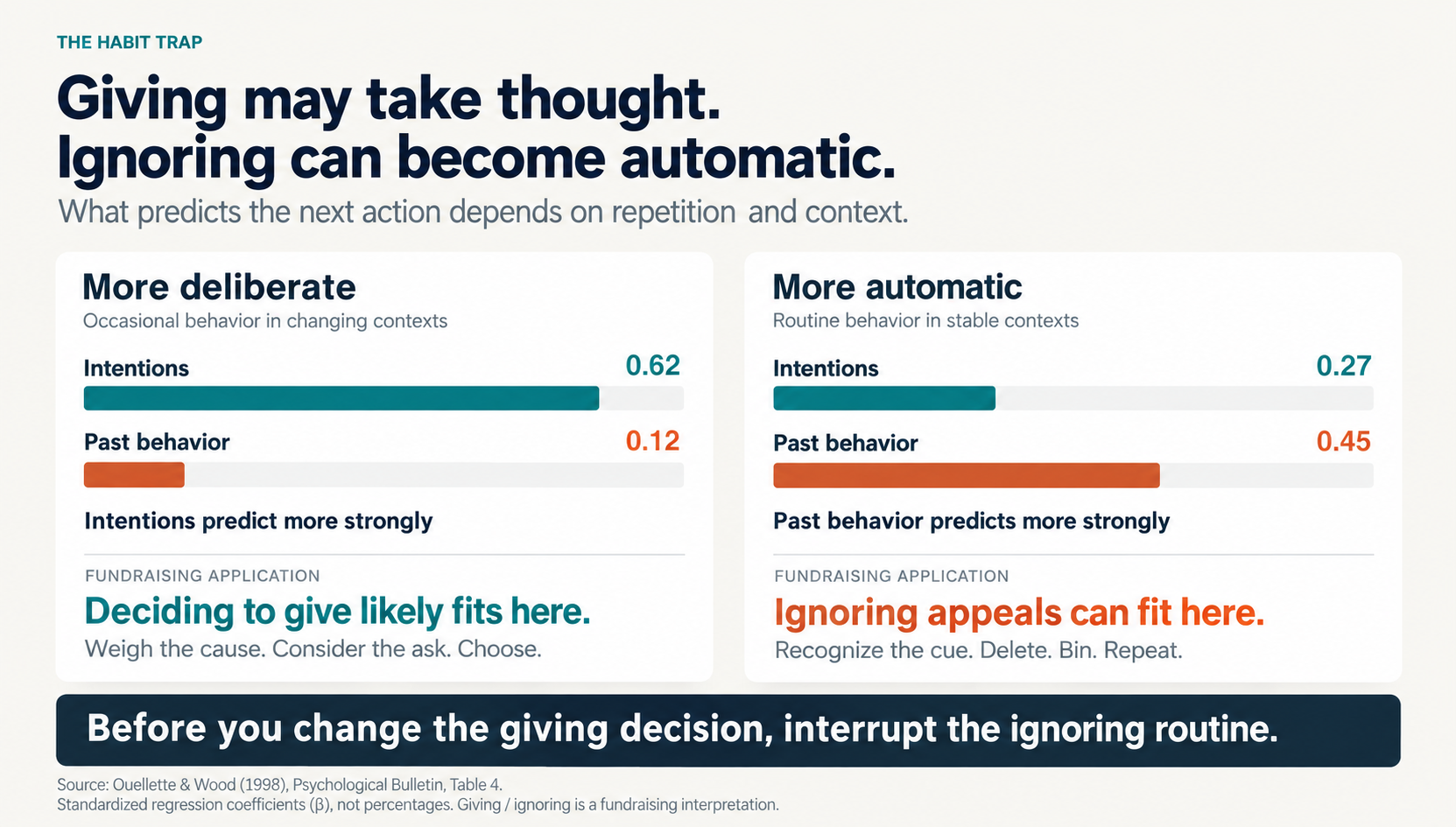
Have we made ignoring the appeal effortless?

Past giving predicts future giving. That’s useful for deciding whom to ask, but it becomes circular when we mistake prediction for understanding. For this reason, I used to dismiss behavior beyond its predictive value but I overlooked an important mechanism: repetition in a familiar setting can make a response automatic. The chart shows why this […]

Learn More